aiken21.blogspot.com

aiken21.blogspot.com
Download your favorite 3D paper

Anime Part 2


Wikipe-tan
Anime (アニメ) (baca: a-ni-me, bukan a-nim) adalah animasi khas Jepang, yang biasanya dicirikan melalui gambar-gambar berwarna-warni yang menampilkan tokoh-tokoh dalam berbagai macam lokasi dan cerita, yang ditujukan pada beragam jenis penonton. Anime dipengaruhi gaya gambar manga, komik khas Jepang.
Kata anime tampil dalam bentuk tulisan dalam tiga karakter katakana a, ni, me (アニメ) yang merupakan bahasa serapan dari bahasa Inggris "Animation" dan diucapkan sebagai "Anime-shon".
Anime pertama yang mencapai kepopuleran yang luas Astro Boy karya Ozamu Tezuka pada tahun 1963. Sekarang anime sudah sangat berkembang jika dibandingkan dengan anime zaman dulu. Dengan grafik yang sudah berkembang sampai alur cerita yang lebih menarik dan seru. Masyarakat Jepang sangat antusias menonton anime dan membaca manga. Dari anak-anak sampai orang dewasa. Mereka menganggap, anime itu sebagai bagian dari kehidupan mereka, Hal ini yang membuat beberapa televisi kabel yang terkenal akan beberapa film kartunnya, seperti Cartoon Network dan Nickelodeon mengekspor kartunnya. Untuk bisa mendapatkan anime, mereka harus membeli DVD/VCD anime atau mereka bisa mengunduh anime itu dari situs-situs penyedia layanan Direct Download Link (DDL). Sekarang anime menjadi sebuah bisnis yang menggiurkan bagi semua orang, dan banyak juga orang yang memanfaatkan hal ini untuk sebuah tindakan kejahatan. Pembuat anime itu sendiri disebut animator.Para Animator itu bekerja disebuah perusahaan media untuk memproduksi sebuah anime. Di dalam perusahaan itu, terdapat beberapa animator yang saling bekerja sama untuk menghasilkan sebuah anime yang berkualitas. Tapi sangat disayangkan, gaji dari para animator tersebut kecil jika dibandingkan dengan kerja keras mereka. Hal ini yang membuat para animator enggan untuk bekerja secara professional. Mereka merasa hal itu tidak sebanding dengan usaha yang telah mereka lakukan. Para animator itu sendiri sering disebut Seniman Bayangan. Karena mereka bekerja seperti seorang seniman yang berusaha mengedepankan unsur cerita dan unsur intrinsiknya.
Pembajakan juga mempersulit para animator untuk mendapatkan keuntungan penuh dari hasil kerja keras mereka, meski ternyata juga ada "gosip" yang mengatakan bahwa ada juga pihak produsen anime itu sendiri yang menyebarluaskan karya mereka diluar jalur perdagangan resmi (mungkin gratisan atau dibajak) dengan tujuan untuk lebih mempopulerkan hasil karya mereka.
Tidak sedikit yang orang yang pergi ke Jepang untuk belajar mengenai pembuatan anime (dan manga tentunya) karena tertarik setelah melihat berbagai anime yang telah menyebar ke berbagai pelosok dunia di berbagai benua. Adapun pihak yang membuat hasil karya yang serupa atau bahkan mungkin meniru ciri anime, misalnya Korea dan beberapa negara Asia lainnya.
Teknologi CG (Computer Graphics) dan Teknologi Visual, Komputer dsb telah mempermudah pembuatan anime sekarang ini, karena itu ada yang menganggap bahwa kualitas artistiknya lebih rendah dibandingkan dengan anime masa lalu. Hanya saja perlu diperhatikan bahwa kualitas gambarnya pun sekarang ini lebih nikmat dilihat dan lebih mudah dimengerti karena gambarnya lebih proporsional dan warnanya lebih bagus, ditambah keberadaan teknologi HD.
Apa itu "anime" dan "manga"?

Anime (アニメ?) (Tentang suara ini dengar ) adalah animasi khas Jepang, yang biasanya dicirikan melalui gambar-gambar berwarna-warni yang menampilkan tokoh-tokoh dalam berbagai macam lokasi dan cerita, yang ditujukan pada beragam jenis penonton. Kata anime merupakan bahasa serapan dari bahasa Inggris "Animation" dan diucapkan sebagai "Anime-shon". Anime dipengaruhi gaya gambar manga, komik khas Jepang. Sekarang anime sudah sangat berkembang jika dibandingkan dengan anime zaman dulu, dengan grafik yang sudah berkembang sampai alur cerita yang lebih menarik dan seru. (baca lebih lanjut...)
Manga (漫画?) (Tentang suara ini dengar ) merupakan kata komik dalam bahasa Jepang; di luar Jepang, kata tersebut digunakan khusus untuk membicarakan tentang komik Jepang. Perbedaan mendasar antara sebutan manga dan komik adalah pembedaan pengelompokan, di mana manga lebih terfokus kepada komik-komik Jepang (kadang juga termasuk Asia), dan komik lebih kepada komik-komik buatan Eropa/negara-negara Barat. Rata-rata mangaka (penulis manga) di Jepang menggunakan gaya sederhana dalam menggambar manga. Tetapi, hampir semua gambar latar belakang manga digambar serealistis mungkin, meski gambar karakternya benar-benar sederhana.

anime chibi

cari anime yang menggemaskan pokoknya chibi banget deh..... klik ja disini

anime chibi


http://manga4nimezon3.blogspot.com/2011/05/chibi-death-note-character.html


Bleach

Bleach Episode #301

Bleach Episode #301 Anime Review

Bleach
© Crunchyroll
With Aizen reaching new levels, the fight against him becomes even more intense.

What They Say:
Ichigo finds himself cornered against Gin's Bankai. But to Ichigo's surprise, Gin advises him to run from this battle. Meanwhile, Urahara, Yoruichi, and Isshin fight Aizen in a three-on-one battle. But none of their attacks appear to work against Aizen.

The Review:
Content: (please note that content portions of a review may contain spoilers)
With the series back on track and dealing with the main storyline again, we saw quite the three hundredth episode previously as it took Aizen and moved him to the next level. While he was already quite powerful, using the Hogyoku has moved him up even further in his transformation. And it's a transformation that at least didn't make him look rather terrible as some others have done. Bleach has narrowed things down at this point overall though, as we're down to just two main battles playing out in a small space, which is what defines this episode.

One thing that had been bothering me with the fight as it stood previously was that for much of it, Ichigo was just standing there watching it, even with Gin pretty much standing right behind him. Gin's role as a trusted man for Aizen has long been interesting to me and I've always thought Gin had a little extra to his personality to make him stand out in a quiet and charming kind of way. With the main battle playing out, he's taking the offensive against Ichigo, pretty much playing with him on some level, which forces Ichigo to allow some of his Hollow side out in order to fight back against him. It's quite a good fight overall, though it's not one that's presented without interruption which does unfortunately slow the intensity of it at times. Gin even manages to get a really nice psychological dig in at him.

A larger portion of the episode focuses on the fight with Aizen himself, which is good, as the trio going against him is definitely interesting to watch since they have a different approach than what we see from Ichigo. Because of age and experience, they're not overconfident but they're not questioning themselves either. They have a variety of paths to try in going after Aizen to see what works and what kind of combination attack they can come up with. While much of Bleach focuses on the 'teenage' heroes who are dealing with their lack of overall experience, when the show shifts to those that are older, it has a very different feeling. It's less emotion based to be sure, but it comes across as far more serious. Not so much that they're doing a job, but they know what needs to be done and just do it. Especially when this is taken in contrast with the way Gin is toying with Ichigo's mind by just talking to him.

In Summary:
While Aizen as a villain falls into a familiar trap pretty much with this episode, both in speaking about things he'd be better off not talking about and not killing everyone just to be done with it, what we get here is the culmination of events that have been going on for essentially the entire series. There's still a long road ahead for it, but watching this while watching the DVD episodes where the Visoreds came into play and Aizen started his plans more openly from Hueco Mundo really helps to cement just how long this has been going on (filler and all!). This episode is good overall, but the frustrating pieces are there, from the bad villain predictable moments to Ichigo being thrown off by Gin's words. Bleach hasn't quite mastered making things truly epic in feeling, but it's getting closer bit by bit.

Bleach Episode #299

Bleach Episode #299 Anime Review

By Chris Beveridge     November 30, 2010
Release Date: November 30, 2010


Bleach
© Crunchyroll
Just days away from the new movie in theaters in Japan, we get an episode the nudges us towards it even more.

What They Say:
While visiting the World of the Living, Rukia comes across Kurumadani, the current Soul Reaper stationed in Karakura Town, being attacked by a mysterious masked man. To her surprise, the masked man reveals himself as Shrieker, the Hollow previously defeated and sent to hell by Rukia and Chad.

The Review:
Content: (please note that content portions of a review may contain spoilers)
As we've seen with other series, such as One Piece, when you can release a new movie based on the franchise that stands alone in its own way, you can tie it to the TV series really well if you do an episode or two in relation to it, giving it the hook to remind viewers to go see it since they tease you well with it. The problem is that you really have to tease well and follow through. One Piece's attempt with Strong World gave us several really bad episodes that I can't say how well they connected with the movie since it hasn't been released over here. So that fell flat for me. And Bleach is likely to fall into the same trap since who knows when it will see the light og day over here.

This episode sets up a fair bit of material that also harkens back to the past as it has Rukia doing a bit of work in the World of the Living as a delivery girl, at least briefly and not exactly consensually. Her time there ends up having her cross with Kurumadami, another Soul Reaper who is located near where Ichigo operates out of. He's kind of an amusing type with the big afro and a lack of overall smarts and skill. He makes up for it with bravery and courage but it's the kind of character that on first blush you know Rukia will be saving more than his being able to help, though he's likely to have more impact later on. Kuru comes across more as something of a slightly goofy unsuccessful yakuza type who does his best but doesn't quite make the grade.

Where the episode digs into the past is in that the pair come across a Hollow who Ichigo had defeated some time ago, though not in any episode I've seen yet on the DVD releases. He's managed to get back to the World of the Living to Rukia's surprise after being cast to hell and he's now quite angry and intense. The difference this time is that Rukia actually has her powers so she can try and tackle him herself. Considering we've not see much of Rukia in the current arc and most of my experiences with her are her non-powered side, it's nice to see her being as involved as she is and still dealing with Kuru.

In Summary:
The first half of the episode is pretty interesting as it deals with this Hollow and the fight against him, but then a good part of the second half goes into the larger picture of setting things up for the movie. Knowing that I have little chance of seeing it anytime soon, it has less impact than a filler episode in its own way. It's the cruel tease to be sure, but it's one that looks fairly interesting because of the setup in the first half. There's some neat creativity in the villains that are being come up with here and the animation and designs for it are well done, though I can't help but feel disconnected from it for the time being because of its nature. While this isn't filler in the traditional sense, it's something just as difficult since it will all be resolved elsewhere, out of sight, out of mind.

Samurai X

Samurai X: Trust and Betrayal, released in Japan as Rurouni Kenshin: Tsuiokuhen (追憶編 Recollection or Reminiscence?), is a four part original video animation series (OVA) that serves as a prequel to the Rurouni Kenshin anime television series. It was released in Japan in 1999. Set during the Meiji Restoration, it tells the story of how Himura Kenshin becomes the Hitokiri Battōsai, and of his relationship with a woman named Tomoe, who would become his first wife.
In 2003, Trust and Betrayal was collected into a two hour feature-length motion picture with new animated sequences and released in North America as a Director's Cut DVD.[1]

Contents

[hide]

[edit] Plot

The story starts off with a bandit raid going on. A young boy named Shinta is saved from death in the bandit raid by Hiko Seijuro. Hiko tells the boy to go to the nearby village and live there. Returning to the site of the attack, he finds Shinta still there, having buried all of the dead, including the bandits. Shinta expresses his regret for not being able to protect the ones he was with, so Hiko offers to properly train him to give him the power to protect. Hiko changes the boy's name to Kenshin, a name he felt was more appropriate for a swordsman.
Years later, during his time as a Hitokiri, Kenshin kills a bodyguard named Kiyosato Akira, who is the fiancé of Yukishiro Tomoe. The encounter with Kiyosato leaves Kenshin with the first half of his cross-shaped scar. After fighting with another assassin, Kenshin meets Tomoe. Kenshin takes her to the inn where he is residing, where the owner mistakes her for a prostitute and nearly sends her away. The presence of her there brings a sort of relief to the stressed men of the Choshu clan, but raises the suspicion of the leader, Katsura Kogoro, who has her investigated covertly.
After the Ikedaya affair, when Kenshin's cover as the shadow Hitokiri is blown, Katsura arranges for Kenshin and Tomoe to hide in the village of Otsu as husband and wife, so the two would not be suspected. After a few months, Tomoe's brother Enishi comes to visit and secretly reveals to his sister that the shogunate spies assigned to track down and kill Kenshin are close by, and that her revenge will be complete. Tomoe sends Enishi off, feeling ill at ease. It is here that Tomoe realises that she has fallen in love with Kenshin. The next day, Tomoe leaves the house and tries to persuade the shogunate men to give up their pursuit of Kenshin, and attempts to kill their leader. Tomoe fails.
The morning of Tomoe's disappearance, Kenshin is visited by a comrade who tells him that the one who set the assassin on him was Tomoe and that she is meeting at that moment with her co-conspirators.
On his way toward the house where Tomoe is supposed to be, Kenshin faces three of the four shogunate agents and becomes badly injured. While Kenshin is fighting with the fourth agent, Tomoe steps in between the two and gets killed in order to save Kenshin's life. Before her death, she gives him the second part of his cross-shaped wound. Kenshin takes her death hard and blames himself, swearing to fight to bring about the age desired by Katsura, and after that to continue fighting to protect down-trodden people without taking another life.

[edit] Production

Daryl Surat of Otaku USA stated that this series uses a more "realistic" art style than the television series uses, and that the series has "graphic, bloody violence galore" beginning in the opening sequence.[2]
One of the major themes of Trust is understanding the repercussions and after-effects murder can have, something that Kenshin has yet to comprehend though others have tried to point it out to him.[3]

[edit] Reception

Animerica reviewer Rio Yañez praised Trust's "introspective take on violence" as well as its being "chock-full of insane samurai sword fights and free-flying appendages" while avoiding stereotypical freeze frame animation. While considering the violence "over the top", he felt it was well handled, avoiding being excessive or gratuitous, and that the action scenes were "well balanced by the lavish background paintings and designs". He did criticize ADV Film's English dub as "kung fu style dubbing", noting that the voice actors frequently mispronounced the Japanese names and left the voice track mildly confusing despite the English script's serious take of the material.[3] Mike Crandol from Anime News Network noted it as one of the greatest OVA series of all-time, celebrating the new characters designs as well as the fights scenes which were also noted to be "terribly bloody" and beautiful at the same time.[4] Although DVD Talk reviewer Don Houston mentioned the OVAs were very violent for teenagers, he found the story and music to be "solid". The director's cut version received positive comments by how the four OVAs were arranged with Houston commenting it "seems more like a movie that stands alone, rather than just the precursor to a long lasting series."[5] Daryl Surat of Otaku USA said that, despite what Dave Riley said, viewers should not watch the Trust & Betrayal series before watching other media, and that viewers should instead watch the television series before watching Trust & Betrayal. Surat explained that the OVA has "great moments" that a viewer unfamiliar with the television series would not "bat an eye toward."[2]

Naruto Shippuden: Dragon Blade Chronicles (Nintendo Wii)

   aruto Shippuden: Dragon Blade Chronicles
Publisher: Tomy Corporation/Atlus
Developer: Takara Tomy
Genre: Action
Release Date: 11/12/2010

While video games based on anime properties have generally fared a little better than their movie counterparts, they do have their fair share of stinkers. After all, video games are a business, and if tacking a well known license onto a poorly conceived game can help sell units, then what company wouldn’t see that as an opportunity? It’s a sad fact that licensed games will generally sell regardless of the quality, the Naruto franchise included. However, the latest release in this franchise, Naruto Shippuden: Dragon Blade Chronicles, hopes to join the ranks of being the next must own title on the Wii. Does it succeed, or should it make like a Shadow Clone and disappear into a puff of smoke?
Let’s Review
Story/Modes
The story revolves around a girl named Akari, a member of a clan of Dragon Guardians who enlists the help of Naruto and other members of the Village Hidden in the Leaves in order stop a revenge plot by her brother, Kuroma. Like many antagonists in the Naruto series, Kuroma had a rough time with being mistreated by society and seeks to gain the power of the Light Dragon to bring vengeance upon the world. Armed with the legendary Dragon Blade, the only weapon that can defeat the Genryu, Naruto embarks on a journey atop Mount Koryu to acquire all the Dragon Orbs before Kuroma and bring a stop to his plans once and for all.
One of the gimmicks of the game is that you will simultaneously be following the exploits of Naruto’s rival, Sasuke Uchiha, as he follows the trail of Akatsuki members to the very same mountain in order to locate his brother Itachi. Sasuke’s story feels very tacked on, however, and means very little to the overall plot of the game. Not that the plot itself is all that good to begin with, as it plays out like a bad filler episode. While I can appreciate the developers attempting to get away from recycling the same story arcs from the series over and over in each game, it’d be nice if what we got was at least interesting. Instead, the story in Dragon Blade Chronicles is predictable, formulaic, and utterly lacking in any sort of meaningful writing.
Now I know what you might be thinking. Some of the story arcs in the Naruto series itself, particularly the filler arcs, have a tendency to be predictable and formulaic as well. The problem here is that the plot attempts to make itself the center of attention, rather than doing what an action game should be doing, which is focusing on the action. Within my first hour of play, I think I spent more than half of it on cutscenes, and not the exciting, action packed quick time event cutscenes either, but the kind where everyone stands around and drones on and on with mountains of meaningless dialogue. Luckily, these cutscenes can be skipped, but it just goes to show how much they detract from the experience.
Story/Modes Rating: Bad
Graphics
If you’ve ever played any of the Naruto: Clash of Ninja Revolution titles, you should know what to expect from the visuals. However, these bland cel-shaded characters have been used since the Gamecube era and have showed their age several games ago. They are fine up close and faithfully adhere to their manga counterparts. When you zoom out at all though, the characters become so pixelated that they are barely recognizable. Is that character talking? You never know in some cases.
The enemies you fight are just plain drab looking. Aside from the bosses, they come in three varieties: floating potato looking things, mud monster foot soldiers, and giant mud monster foot soldiers. The only real difference between them is palette swapped colors and the weapons they carry. The backgrounds are equally as unexciting to look at considering you spend the bulk of the game just climbing the same mountain. This isn’t to say the scenery doesn’t change at all, but it goes from volcanic mountain to desert mountain to mountain mountain. In short, pretty bland.
You would think dated graphics would mean that the game could at least run at blazing speeds, am I right? Unfortunately, Dragon Blade Chronicles can only handle a few enemies on the screen at one time before performance screeches to a halt. There were even a few scenes where all I was doing was running down a hallway and the frame rate took a noticeable plummet. I can’t believe any of this passed as acceptable.
Graphics Rating: Dreadful
Sound
For purists, there’s really only one question that needs to be answered, so I’m just going to tell you right now: no, you cannot enable the Japanese voice track. I think that pretty much just killed the desire to play this game for several of you, but for those of you who could care less, the quality of the English dub is up to par with what you would find in the anime. It should come as no surprise that if you like the dubbed voices in the series, you’ll like them here. If you can only tolerate the Japanese, you will perhaps go insane, or refuse to play the game. I personally enjoy the English cast, even if Naruto’s voice can be a bit grating at times. Though, I feel the Japanese Naruto is grating as well, but that’s just my opinion.
The soundtrack is serviceable, if a bit lacking in variety. You’ll generally have a single track play through the entirety of a stage that will loop continuously, even if you hit the game over screen. It will occasionally change up if you are fighting a boss or watching a cutscene, but for the most part you’ll be hearing the same few songs repeatedly throughout your experience.
Sound Rating: Decent
Control/Gameplay
The nice thing about the control scheme in Dragon Blade Chronicles is that you have options. You can opt for the Wiimote/nunchuk combo, the classic controller, or a Gamecube controller. Since most people are going to have access to the Wiimote/nunchuk combo, I opted to give that a whirl. It certainly did its job admirably and limited itself to only one task for motion controls, which wasn’t even a major one at that.
Rather than being a fighting game like its Clash of Ninja Revolution counterparts, Dragon Blade Chronicles is instead more of an action title with some platforming elements. You have buttons mapped to jumping and attacking as expected, but you can also dodge attacks, push and pull objects, and even map skills to your remaining buttons as you pick them up during the game. It’s a simple control scheme that you can customize accordingly, which is nice and allows you to choose a method of playing that’s most comfortable for you.
That being said, no customization in the world can compensate for the awful platforming you are forced to endure. Naruto and Sasuke both jump like they have weights attached to their legs and seem to be unable to grasp ledges that are within reach. In other words, they’re not very ninja-like. What’s worse is that when you miss a jump and fall to your death, it’s an immediate game over and you are sent back to your last checkpoint. The frustration is even further compounded when you realize that getting hit while in midair is equally as likely to send you to your death, much like the Castlevania and Ninja Gaiden games of old.
For as well mapped out as the other functions are, it would have been nice to have some form of camera control. As it stands, the game is not very intelligent in determining which way you want your view to face and getting too close to a wall will get you exactly that: the wall. There are even instances where getting too close to the sides will send the camera into an uncontrollable spasm until you back away and things return to normal. Granted, there isn’t a whole lot to really see in this game, but if you’re going to take control away from the player, at least have a functional substitute in place.
In addition to your health meter you are given a chakra meter which monitors how often you can use your various special skills and jutsus, both of which can be extended if you collect enough items. You also have a meter tied to whichever ally you have with you at a given time. While you don’t physically see them while in battle, you can summon them to perform an attack or some other support skill when their meter is full. For example, having Shikamaru along allows him to throw paper bombs at the enemies for you, while Sakura will heal you if your health is low.
Naruto carries with him the Dragon Blade which can be imbued with a particular element once acquired. For example, if you equip the water orb, you can inflict more damage to fire based enemies, that type of thing. The problem here is that the game isn’t always clear as to what elements are effective against what, or even what element certain enemies belong to. With a little experimentation, you can figure it out yourself, but it’s still frustrating to hear Kakashi say “Use a jutsu that’s effective against wind!” only to shrug your shoulders and go “Um, which one?”
Control/Gameplay Rating: Mediocre
Replayability
There are two difficulty levels in this game: Easy and Hard. Fans of the game should get at least two playthroughs out of it, more for the completionists who want to find all the collectibles and unlock all the little in-game achievements. Even with that, the game can be cleared in just a few hours on your first playthrough. If you were to skip all of the cutscenes you could blaze through the game in one sitting. There’s really not much to do in the story mode and it’s a shame considering what has been done in other Naruto titles.
There is a versus mode that you can choose to partake in, but it is sadly lacking. One player has to be Naruto, and the other must be Sasuke. You can choose how many rounds you fight and you can set your handicaps, but that’s it. The stages are chosen at random and any skills you acquire appear at random throughout the arena. It even runs off the same clunky engine that the main game does. A lot of games present a multiplayer mode that is merely an afterthought, but few have ever felt as tacked on as this one does. It’s such a waste of time, I’d hardly consider it for replay value.
Replayability Rating: Dreadful
Balance
This is a game of extremes. On the one hand, the majority of the game is incredible easy due to the simple fact that just about every enemy can be killed by repeated use of the same three or four hit combo (depending on what character you’re using), and that’s if you decide to fight at all. In many stages, you can run past all the enemies and make your way to the goal unhindered for the most part, until you run into a room where you have to defeat all the enemies to progress. You don’t encounter these very frequently, however, and without any incentive for defeating said enemies it is in your best interest to avoid conflict when necessary.
On the other end of the spectrum, there is the terrible platforming that I mentioned above. There are also moments, particularly during boss battles, where you may get struck by an attack or series of attacks that, once they connect, can drain your entire health bar before you can even react. Without giving away too much, I struggled with the final battle due to an attack that lifted you up into the air and subjected you to other attacks without the ability to retaliate. Often this meant failure with just one blow. Forget about difficulty setting, the challenge is uneven in both and really doesn’t provide much of a different experience between each other.
Another thing that bears mention is how some of the puzzles in the game are often hindered by technical issues. I got stuck in the first Sasuke section, going around in circles even though I knew what the solution was all along. However, the skill I used to destroy a particular piece of the landscape didn’t work even though I saw it pass right through the object. This led me to believe I got the solution wrong when, in fact, it was the game’s poor collision detection that made me resort to running in circles again.
Balance Rating: Awful
Originality
Not only are Naruto games nothing new, but neither are they new to this genre. Rise of a Ninja and The Broken Bond are the standard to which I hold all other Naruto games, and compared to those, Dragon Blade Chronicles is a slapped together mess. I love the Naruto show, and I still thought the three hours it took me to play through this game was too long. Even the Clash of Ninja Revolution titles, as little as they innovate from each other, are much easier to recommend than this game. Everything you see here has been done in other titles, and much, much better.
Originality Rating: Awful
Addictiveness
I’ll be honest, I wanted to quit playing within the first hour. Part of that can be attributed to the overly lengthy and pointless cutscenes. The other part due to the utterly unexciting and generic combat. An action title such as this should not only encourage you to engage in combat with enemy characters, but also make it fun. Naruto Shippuden: Dragon Blade Chronicles does neither of these things, and as a result will drive people to give up on what is already a short adventure.
he popular Naruto series has everything you need to make a great game; fantastically unrealistic ’anime physics’ can lend themselves to exciting fights, and the diverse cast of ninjas also gives you lots of ideas to work with. What Dragon Blade Chronicles on the Wii does is take that setting and use part of its story in a third person brawler, one letting you play both titular hero Naruto as well as Sasuke as they fight through hordes of enemies, explore large stages, and fight a variety of bosses. It should have been a great game, and it almost is... except several technical problems drag it down.

Most of your play is split between two activities; fighting and exploring across large 3D stages, or watching the plot unfold through detailed, often fully voiced cutscenes. While Dragon Blade Chronicles is primarily a brawler with platforming elements mixed in, it definitely doesn’t skimp on the story and series fans will probably find much to like here. The fighting is basic but not completely devoid of detail; you have your typical "press Attack a lot to do a combo" techniques and multi-jumps, but can also collect scrolls with special moves on them. These are easy done; assign them to a button on the d-pad and simply press that direction to release blasts of fire, create mud-wall platforms to jump on, fling shuriken, and more.

While much of that has been seen before in other games, it is competently done. Even boss fights have good variety to them, with foes ranging from enormous dragons to an enemy flying through the air while you can only jump from platform to platform in pursuit; fighting from the ground is impossible since it’s covered in landmines. These are all really good parts of the game, and if it had been refined a little more Dragon Blade Chronicles would be fun even for those not familiar with the Naruto series. So what went wrong?

Technical flaws are the main issue here. The worst of these is the camera; it probably sounds cliche to complain about that in a review by now, but it genuinely is a problem in Dragon Blade Chronicles. It works fine when you’re moving forward in a level, but most of them require backtracking and even when you’re heading back it stays firmly looking ’ahead’, so it’s almost impossible to tell where you’re going and you could easily fall off some platforms to an instant death in this way. Almost as bad is the game’s regular drops in framerate; certain environments and combinations of enemies cause Dragon Blade Chronicles to begin running at what seems to be half or even one-third regular speed. It’s not done for dramatic emphasis... it happens even against basic enemies and in places where you’re expected to act as quickly as possible.

These two problems really weigh Dragon Blade Chronicles down. It has most of the elements of a good game, but a bad camera and regular framerate drops make it hard to play. Even the addition of a versus mode for you and a friend to go head-to-head doesn’t do much to make up for this, and that’s really too bad. The game could have been anywhere from genuinely good to outright amazing, but when it’s so difficult to do even basic things much of the charm is lost. If you’re not already a fan of Naruto, this game won’t do anything for you. And if you do like the series then perhaps you would be better served by the other Naruto Shippuden game released around the same time as this one: Naruto vs. Sasuke for the Nintendo DS, while it’s in a wholly different genre (2D platformer), it’s much better.


Anime

  • Bleach

    Ichigo Kurosaki has always been able to see ghosts, but this ability doesn't change his life nearly as much as his close encounter with Rukia Kuchiki, a Soul Reaper and member of the mysterious Soul Society. While fighting a Hollow, an evil spirit that preys on humans who display psychic ...
    • Full Metal Alchemist

      "Humankind cannot gain anything without first giving something in return. To obtain, something of equal value must be lost. That is alchemy's first law of equivalent exchange. In those days we really believed that to be the world's one and only truth." In an alchemical ritual gone wrong, Edward Elric ...
      • Soul Eater

        Maka is a scythe technician, working to perfect her living scythe and partner, Soul Eater. By feeding on the souls of 99 humans and one witch, Soul Eater aspires to become the perfect weapon–the Death Scythe! Along the way, the two will face innumerable challenges, including an enormous cat, thieves, ...
        • One Piece

          Seeking to be the greatest pirate in the world, young Monkey D. Luffy, endowed with stretching powers from the legendary "Gomu Gomu" Devil's fruit, travels towards the Grand Line in search of One Piece, the greatest treasure in the world.

templet for blogspot anime


cari templet yang cute buat blog kamu disini......


http://freeanimetheme.blogspot.com


                                                                      http://btemplates.com

game anime simulation

download disini
 nekomura game.....


http://www.nekomuragames.com/games/cute-rpg/index.html
http://www.nekomuragames.com/games/visual-novel/imaginary-realm-2.html
http://www.nekomuragames.com/games/cute-rpg/index.html

Uchiha Sasuke vs Uchiha ithachi

Sasuke Uchiha (うちはサスケ Uchiha Sasuke?) adalah seorang karakter fiktif dari komik dan anime Naruto. Nama depan Sasuke, konon berasal dari nama seorang ninja legendaris, Sarutobi Sasuke. Sedangkan nama belakangnya, "Uchiha" dibaca sebagai "uchiwa", atau "kipas kertas" (kipas yang terbuat dari kertas). Pada zaman Jepang Kuno, uchiwa seringkali dipakai dalam upacara kerajaan, sebagai souvenir, atau digunakan untuk melindungi prajurit dari serangan anak panah. Namun menurut filosofi dalam komik Naruto, "uchiwa" adalah sebuah kipas yang mampu mengobarkan bara menjadi api, yang menggambarkan
 kemampuan klan Uchiha yang mampu menggemblang keturunan mereka menjadi seorang ninja yang hebat.
Dalam seri Naruto, Sasuke adalah seorang ninja jenius dari sebuah klan terkemuka di Konoha, Klan Uchiha. Klan Uchiha dikenal dengan garis keturunan khususnya yaitu Sharingan, begitu juga dengan kemampuan mereka menguasai elemen api. Klan ini juga memberikan kontribusi besar sebagai pasukan keamanan Konoha. Seperti kebanyakan anggota klan Uchiha, Cakra Sasuke lebih mengarah ke elemen api, namun dia juga dapat memanipulasi elemen listrik, seperti yang ditunjukkannya saat melakukan jurus Chidori. Sasuke juga berhasil menguasai jutsu Amaterasu yang dia dapat dari kakaknya, Itachi Uchiha.

  1.           Latar belakang

Dalam seri Naruto, Sasuke adalah adik dari Itachi. Itachi merupakan anak pertama dari Kepala Pasukan Keamanan yang dihormati seluruh desa sebagai jenius karena menyelesaikan pendidikan sebagai genin pada usia 7 tahun, menguasai Sharingan pada usia 8 tahun, lulus ujian Chuunin pada usia 10 tahun, dan menjadi kepala pasukan ANBU pada usia 13 tahun. Klan Uchiha menghormati Itachi dan memberi harapan penuh kepadanya sebagai penghubung antara desa dan klan. Ayah Sasuke, Fugaku Uchiha memberikan perhatian lebih kepada Itachi, sehingga membuat Sasuke iri kepada kakaknya.
Setelah kejadian antara Itachi dan beberapa anggota klan Uchiha lainnya, hubungan antara ayah Sasuke dan Itachi menjadi sedikit renggang. Itachi menjadi lebih menakutkan dan mempertanyakan keberadaan dirinya sebagai "wadah" (utsuwa) klan. Selama waktu itu, ayah Sasuke kemudian mengajari Sasuke sebuah jurus berelemen api, yaitu Goukakyuu no Jutsu. Sasuke dapat menguasai jurus tersebut dalam waktu satu minggu, membuat ayahnya terkejut dan akhirnya mengakui Sasuke sebagai anggota klan Uchiha yang sebenarnya. Ayah Sasuke juga memperingatkan agar kelak Sasuke tidak mengikuti jejak kakaknya.
Tidak lama setelah hari itu, Sasuke menemukan seluruh anggota klannya habis dibantai oleh Itachi, termasuk ayah dan ibunya. Itachi mengatakan bahwa Sasuke tidak berharga untuk dibunuh. Dalam komik Naruto volume 25, Itachi mengatakan bahwa Sasuke dibiarkan hidup karena dia selalu ingin mengalahkan Itachi. Itachi juga memberitahukan rahasia dan sejarah tersembunyi di balik mata Sharingan. Itachi berkata bahwa untuk menguasai Mangekyou Sharingan, Sasuke harus membunuh teman terdekatnya. Mendadak Sasuke jatuh tersungkur lalu terbangun di Rumah Sakit Konoha.

Kemudian Sasuke pergi menuju ke kuil Nakano dan menemukan rahasia yang diberikan Itachi. Mulai saat itu, Sasuke memutuskan bahwa dia hidup hanya untuk membalas dendam dan membunuh Itachi.

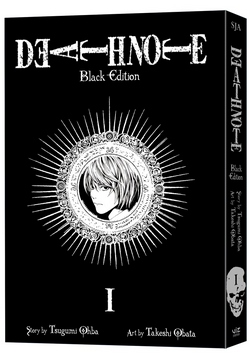
Black editions


deathnoteblackedition.jpg
Death Note Black Edition Volume 1 3D image

A SHINIGAMI DEATH GOD AND THE HUNT FOR AN ‘ETHICAL’ SERIAL KILLER TO ENTHRALL THE MANGA WORLD AGAIN IN THE RELEASE OF VIZ MEDIA’S DEATH NOTE BLACK EDITION
New Edition of the Riveting Supernatural Crime Mystery Features A Larger Size And Added Full Color Pages
VIZ Media, LLC (VIZ Media), one of the entertainment industry’s most innovative and comprehensive publishing, animation and licensing companies, has announced the release of DEATH NOTE BLACK EDITION, an oversized version of the acclaimed supernatural crime thriller. Volume 1 hits stores on December 28th and includes the first two editions of the popular manga (graphic novel) series as well as added full-color pages. The DEATH NOTE BLACK EDITION will be offered under the Shonen Jump Advanced imprint, is rated ‘T+’ for Older Teens, and will retail for $14.99 U.S. / $16.99 CAN.
Light Yagami is an ace student with great prospects—and he’s bored out of his mind. But all that changes when he finds the Death Note, a notebook dropped by rogue Shinigami death god. Any human whose name is written in the notebook dies, and now Light has vowed to use the power of the Death Note to rid the world of evil. But when criminals begin dropping dead, the authorities send the legendary detective L to track down the killer. With L hot on his heels, will Light lose sight of his noble goal…or his life?
“DEATH NOTE took the manga world by storm and became an international bestseller with its sinister plot and captivating artwork,” says Beth Kawasaki, Sr. Editorial Director. “The BLACK EDITION is an ideal way for those who never read the original series to finally see what the buzz is all about in six volumes versus the original 12-volume run. For established fans or anyone that might have missed later DEATH NOTE volumes, the new version also presents a great opportunity to revisit the series with its larger trade paperback size, new cover design, and bonus color pages.”
The original DEATH NOTE series, a 12-volume mystery created by writer Tsugumi Ohba and artist Takeshi Obata, continues to be a must-read among legions of ardent fans, having sold over 1.2 million copies in the U.S. to date. DEATH NOTE has spawned not only a fanbook (DEATH NOTE: HOW TO READ 13) and two novels (DEATH NOTE ANOTHER NOTE: THE LOS ANGELES BB MURDER CASES and DEATH NOTE: L, CHANGE THE WORLD), all published by VIZ Media, but also a 37-episode animated series (available streamed online for free at VIZAnime.com and on DVD from VIZ Media), three live-action feature films and a plethora of related posters, toys and action figures. The DEATH NOTE manga and anime are both rated ‘T+’ for Older Teens.
For more information on DEATH NOTE, please visit DeathNote.viz.com.
To view animated DEATH NOTE episodes for free, please visit www.VIZAnime.com.
For more information on other Shonen Jump titles, please visit www.ShonenJump.com.

† orange range †

Orange Range (オレンジレンジ) merupakan grup band asal Jepang yang berada dibawah naungan label rekaman Sony Music Jepang. Lagu-lagu mereka banyak yang menjadi soundtrack dorama, film, maupun anime, seperti Ima, Ai ni Yukimasu (Hana & Kizuna), Naruto (Viva★Rock) dan Bleach (* ~Asterisk).

Singel

  • Michishirube (ミチシルベ ) (Indies) (25 Agustus 2002)
    1. Michishirube (ミチシルベ )
    2. MIDNIGHT GAGE
    3. Kirikirimai ~Ryukyudisko Remix~ (キリキリマイ ~リューキューディスコRemix~)
  • Kirikirimai (キリキリマイ) (4 Juni 2003)
    1. Kirikirimai (キリキリマイ)
    2. Samurai Mania (サムライマニア)
    3. Kirikirimai ~Yamadahisashi Roudoku ver~ (キリキリマイ~やまだひさし朗読Ver.~)
    4. Kirikirimai ryukyudisco mix (キリキリマイ ryukyudisco mix)
    5. Tentenkomui (テンテコマイ)
  • Shanghai Honey (上海ハニー) (16 Juli 2003)
    1. Shanghai Honey (上海ハニー)
    2. New Tokyo Machine (ニュー・トウキオマシン)
    3. Shanghai Honey ~ Ryukyudisco Remix~ (上海ハニー ~ryukyudisco remix~)
    4. Shanghai Honey ~Shanghai Style~ (上海ハニー ~上海style~)
  • Viva★Rock (ビバ★ロック) (22 Oktober 2003)
    1. Viva Rock (ビバ★ロック)
    2. Velocity 3000 (ベロシティー3000)
    3. Viva Rock ~Ryukyudisco Remix~ (ビバ★ロック~ryukyudisco remix~)
    4. Nagisa no Roko Girl (渚のロコガール)
    5. Viva Rock ~Japanese Side~ (ビバ★ロック~japanese side~)
  • Rakuyou (落陽) (27 November 2003)
    1. Rakuyou (落陽)
    2. Party Night (パーリィナイッ)
    3. Rakuyou ~Ryukyu Acoustic Mix~ (落陽 ~ryukyu acoustic mix~)
  • Michishirube ~a road home~ (ミチシルベ) (25 Februari 2004)
    1. Michishirube ~A Road Home~ (ミチシルベ~a road home~)
    2. Zung Zung Funky Music
    3. Yamauchi Chuukouka (山内公園)
    4. Michishirube ~A Road Home Ryukyudisco Remix~ (ミチシルベ~a road home・ryukyudisco remix~)
  • Locolotion (ロコローション) (9 Juni 2004)
    1. Locolotion (ロコローション)
    2. Monkey Magic
    3. Orange Boat
    4. Locolotion ~Ryukyudisco Remix~ (ロコローション~RYUKYUDISCO REMIX~)
  • Chest (チェスト) (25 Agustus 2004)
    1. Chest (チェスト)
    2. Shuuji kun (修二君)
    3. Kirikirimai Disco Mix (キリキリマイ DISCO MIX)
    4. Chest Live Mix? featuring Paul Gilbert (チェスト LIVE MIX? featuring PAUL GILBERT)
  • Hana (花) (20 Oktober 2004)
    1. Hana (花)
    2. Kasō (花想)
    3. Hana (Original Track) (花 original track)
  • * ~Asterisk~ (*~アスタリスク~) (23 Februari 2005)
    1. *~Asterisk~ (*~アスタリスク~)
    2. Mission in Taisakusen (ミッション in 大作戦)
    3. Spiral (スパイラル)
    4. * ~Asterisk~ (Romantic Ver.) (*~アスタリスク~ ロマンティックVer.)
  • Love Parade (ラヴ・パレード) (25 Mei 2005)
    1. Love Parade (ラヴ・パレード)
    2. Okihabara Inaa O-721 (沖葉原イナー O-721)
  • Onegai! Señorita (お願い!セニョリータ) (8 Juni 2005)
    1. Onegai! Señorita (お願い!セニョリータ)
    2. Nettai Night (ねったいナイト)
    3. Hai! Moshimoshi...Natsu Desu! (はい!もしもし・・・夏です)
  • Kizuna (キズナ) (24 Agustus 2005)
    1. Kizuna (キズナ)
    2. Soy Sauce no Theme (ソイソースのTheme)
    3. Ho Ho Ho (ほほほ)
    4. Kizuna ~Acoustic Ver.~ (キズナ)
  • Champione (チャンピオーネ) (10 Mei 2006)
    1. Champione (チャンピオーネ)
    2. Walk on
  • UN ROCK STAR (30 Agustus 2006)
    1. UN ROCK STAR
    2. Fuurinkazan (風林火山)
    3. My Rifle feat. Petunia Rocks (マイ・ライフル ~feat.ペチュニアロックス~)
    4. U topia ~LIVE TOUR 005 ИATURAL~
  • SAYONARA (25 Oktober 2006)
    1. SAYONARA
    2. YARISUGI Manbou (YARISUGI マンボウ)
    3. Lonely Fighter (ロンリーファイター)
  • Ika SUMMER (イカSUMMER) (25 April 2007)
    1. Ika SUMMER (イカSUMMER)
    2. SJK06
    3. DANCE 2 ~DJ KAGAMI REMIX~
  • Ikenai Taiyou (イケナイ太陽)(18 Juli 2007)
    1. Ikenai Taiyou (イケナイ太陽)
    2. Iketenai Taiyou (Instrumental) (イケテナイ太陽)
  • Kimi Station ((君station) (5 Maret 2008)
    1. Kimi Station (君station)
    2. powder beats
    3. LaLaLa ((仮)ラララ)
  • O2 (28 Mei 2008)
    1. O2
    2. Harujion (春紫苑)
    3. Sekai World Uchinaanchu Kikou (DJ TASAKA REMIX) (世界ワールドウチナーンチュ奇行)
  • Oshare Banchou feat. Soy Sauce (12 November 2008)
    1. Oshare Banchou feat. Soy Sauce (おしゃれ番長 feat.ソイソース)
    2. reason
    3. Beat it ~from PANIC FANCY~ DEXPISTOLS Remix
  • Hitomi no Saki ni (8 Juli 2009)
    1. Hitomi no Saki ni (瞳の先に)
    2. crystal
    3. おしゃれ番長 ~80kidz Remix~

[sunting] Mini-Album

  • Orange Ball (22 Februari 2002)
    1. Soujuuko (奏重鼓)
    2. Gadget Groove (ガジェットグルーヴ)
    3. Kirikirimai (キリキリマイ)
    4. Flower Garden (フラワーガーデン)
    5. Chuudoku (中毒)
    6. Velocity (ベロシティー)
    7. Funk Tune (ファンクテューン)
    8. Soujuuko -RKDRMX- (奏重鼓)

[sunting] Album

  • 1st Contact (17 Desember 2003)
    1. Fever!
    2. Shanghai Honey (上海ハニー)
    3. Mission in Poppiple (ミッションinポッピプル)
    4. Young 8 (ヤング8)
    5. Samurai Mania (サムライマニア)
    6. Yuugu Red (ゆうぐレッド)
    7. Viva★Rock (ビバ★ロック)
    8. Japanese People (ジャパニーズピープル)
    9. Party Night (パーリィナイッ)
    10. O-MO-I
    11. TWISTER
    12. Velocity 3000 (ベロシティー3000)
    13. Kirikirimai ~Album Ver.~ (キリキリマイ)
    14. Rakuyou ~Long Ver.~ (落陽)
    15. Ambienta (アンビエンタ)
    16. Yamauchi-chuu Kouka (山内中校歌)
  • musiQ (1 Desember 2004)
    1. KA・RI・SU・MA
    2. Chest (チェスト)
    3. Locolotion (ロコローション)
    4. Ishin Denshin (以心電信)
    5. ZUNG ZUNG FUNKY MUSIC
    6. Padi Bon Mahe (パディ ボン マヘ)
    7. City Boy (シティボーイ)
    8. Xie Xie (謝謝)
    9. Danshi-ing session (男子ing session)
    10. Beat Ball
    11. Michishirube ~a road home~ (ミチシルベ)
    12. Hana (花)
    13. FULLTHROTTLE
    14. Matsuri Danshaku (祭男爵)
    15. papa
    16. HUB☆STAR
    17. Oh! Yeah
    18. SP Thanx
    19. Zipangu 2 Zipangu (ジパング2ジパング)
  • ИATURAL (12 Oktober 2005)
    1. yumekaze
    2. Yumejin (夢人)
    3. Onegai! Señorita (お願い!セニョリータ)
    4. Winter Winner
    5. CRAZY BAND
    6. Ame (雨)
    7. GOD69
    8. HYSTERIC TAXI
    9. pe nyom pong
    10. Sakadzuki Jammer (盃 Jammer)
    11. * ~Asterisk~ (*~アスタリスク~)
    12. sunrise
    13. U topia
    14. BETWEEN
    15. re-cycle
    16. Kizuna (キズナ)
    17. Love Parade (ラヴ・パレード)
    18. Иatural Pop
    19. Kirikirimai ~Fantastic Four Remix~

    Death note Layar Lebar

              
    Dalam versi layar lebarnya, Death Note dibagi menjadi tiga bagian, yaitu Death Note, Death Note: The Last Name, dan Death Note: L Change The World.

                  Death Note

    Death Note
    Cerita Death Note berawal ketika Light Yagami menemukan sebuah buku yang ternyata milik Shinigami (Dewa Kematian) bernama Ryuk (Ryuku). Di dalam Death Note milik Ryuk, terdapat cara menggunakan Death Note yang ditulis olehnya sendiri. Death Note ini kemudian digunakan untuk mewujudkan idealismenya yaitu untuk menciptakan dunia baru yang bersih dari kejahatan, dengan dirinya sebagai Dewa.
    Kemudian Death Note ini dia gunakan untuk membunuh para kriminal. Mendapatkan data para kriminal dari televisi maupun mencuri data kepolisian pusat (ayahnya, Shoichiro Yagami adalah seorang polisi). Ternyata tindakannya ini mengundang berbagai reaksi, baik dari masyarakat, para petinggi Jepang, bahkan dari para petinggi internasional. Kebanyakan masyarakat setuju dengan tindakan pembersihan dunia itu, namun para petinggi tidak menyetujuinya karena tindakan tersebut bertentangan dengan Hak Asasi Manusia.
    Tidak hanya itu hambatan yang ditemui Raito (yang dijuluki KIRA, sebutan untuk Killer dalam dialek Jepang) untuk mewujudkan dunia yang bersih, dia juga harus berhadapan dengan L yang selanjutnya dikenal dengan nama Ryuzaki (nama asli L adalah L Lawliet). L adalah seorang detektif profesional muda bertaraf internasional yang hanya bergerak di belakang layar. Setelah bertemu L Lawliet, jalan cerita "Death Note" menjadi semakin menarik (ditambah dengan munculnya Kira Kedua dan sebagainya, dalam versi anime dan manganya).

    [sunting] Death Note: The Last Name

    Death Note 2
    Death Note: The Last Name menceritakan tentang Kira Kedua yaitu seorang artis yang baru naik daun bernama Misa Amane, diceritakan juga asal usul mengapa Misa memiliki buku Death Note yang kedua. Misa memiliki buku death Note yang kedua karena dewa kematian yang selalu menjaga Misa (bernama Jealous) mati untuk menyelamatkan Misa yang akan dibunuh oleh seorang penjahat. Jelaous memperpanjang umur Misa, namun dengan begitu maka Jealous hancur menjadi pasir. Jealous kemudian meminta sahabatnya yang juga dewa kematian bernama Rem, Rem kemudian menjaga Misa dan mengajarkan bagaimana cara menggunakan Death Note. Misa yang telah kehilangan seluruh keluarganya karena dibunuh oleh seorang perampok. Misa yang melihat wajah pembunuh itu kemudian melaporkan pembunuh itu, namun karena kesaksian Misa tidak cukup kuat, maka pencuri itu kemudian dibebaskan. Misa yang sedih berlarut-larut dalam kesedihannya kemudian melihat berita bahwa pencuri itu telah mati karena serangan jantung. Misa Amane kemudian sangat memuji KIRA.
    Light Yagami kemudian dicurigai oleh L sebagai Kira. Saat sedang diinterogasi dalam Markas Besar L, ternyata Kira Kedua beraksi dengan 'mata'-nya. Kira Kedua membunuh semua yang menentang KIRA. Kira Kedua memberikan sebuah rekaman suara yang menginginkan agar semua orang menyetujui kira yang dikirimkan ke Sakura TV. Kemudian datanglah Ayah Light (Shoichiro Yagami) ke stasiun TV itu. Di Stasiun TV sakura, Shoichiro kemudian memaksa Produser Sakura TV untuk menghentikan acara itu, karena ditodong pistol, produser itupun kemudian terpaksa menghentikan acara tersebut.
    Khawatir akan Kira dan Kira Kedua bertemu, L memerintahkan untuk membuat rekaman suara yang isinya adalah untuk agar Kira Kedua menyerahkan diri sebelum bertemu dengan Kira I. Tanpa disangka-sangka, ternyata Kira Kedua, Misa Amane telah jatuh cinta kepada Light (Kira). Misa kemudian mendatangi rumah Light dan menyerahkan Death Notenya. Misa meminta agar Light menjadi kekasihnya.
    L menemui Light di kampusnya sambil menanyakan kedatangan Misa kerumahnya kemarin malam. Ryuzaki yang memakai topeng kemudian bertemu dengan Misa Amane. Misa kemudian membaca nama asli Ryuzaki. Misa kemudian dirubungi oleh para Fansnya di kampus Light dan menyatakan bahwa Light adalah kekasih Misa. Dikerumunan itu, Ryuzaki mengambil Handphone Misa. Ketika Misa dan Ryuzaki pergi, Light menelepon Misa yang kemudian diangkat oleh Ryuzaki. Dilain sisi, Misa sudah diamankan oleh polisi anak buah Ryuzaki.
    Misa dipaksa untuk mengatakan apakah dia adalah kira dan siapakah kira I, namun karena cintanya kepada Light Yagami, dia tetap diam. Misa kemudian meminta Rem menghapus memori tentang death note dari pada dia harus mengatakan Light adalah Kira I. Rem kemudian mendatangi Light dan mengancam akan membunuh Light jika sesuatu terjadi kepada Misa. Light kemudian menyembunyikan Death Note yang dimilikinya dan menyuruh Rem untuk mencari pemilik Death Note baru, Rem yang ingin Misa selamat kemudian menyetujui Light dan pergi mencari orang untuk menjadi Kira III.
    Rem kemudian menyerahkan Death Note-nya kepada seorang gadis di Sakura TV bernama Yamada. Yamada kemudian membunuhi para penjahat dan menyiarkan di TV untuk Mensuport Kira. Misa yang telah kehilangan ingatannya kemudian mulai berbicara tentang Light, namun hanya mengatakan tentang masa pacaran dan bertemunya di Sakura TV. Lightpun kemudian menghilangkan ingatannya, Light dan Misa kemudian dibebaskan. Light yang kehilangan ingatannya tentang Death Note kemudian membantu Ryuzaki untuk mencari Kira III. Dengan bantuan Light, kemudian Kira III ditemukan dan dijebak dengan ancaman bahwa video pengintai kamarnya akan diberitahukan kepada seluruh dunia. Takut akan ancaman tersebut, Yamada kemudian nekat untuk menuliskan nama orang yang akan menyiarkan videonya didalam Death Note. Yamada yang mengetahui bahwa dia tak bisa membunuh orang itu kemudian datang ke Sakura TV. Disana semua agen polisi, Ryuzaki dan Light memegang buku itu dan dapat melihat Rem. Light yang menyentuh Death Note itu kemudian mengingat masa lalunya bersama Death Note. Light yang sudah ingat kemudian menuliskan nama Yamada dibalik jam tangannya dimana dia menaruh secarik kertas dari death note. Kematian Yamada kemudian menjadi misteri.
    Light yang sudah mengingat kembali masa lalunya bersama Death Note kemudian menyuruh Misa yang telah dibebaskan untuk mengambil Death Note-nya yang dia sembunyikan dahulu. Misa yang menemukan Death Note itu kemudian mengingat lagi masa lalunya dan dapat melihat Ryukk (Dewa Kematian Death Note). Misa kemudian mulai membunuhi orang-orang lagi. Ryuzaki kemudian mengundang Misa ke Markas Besar, saat itu, dia juga menyuruh Soichiro Yagami untuk menyerahkan Death Note yang ada di markas besar ke FBI. Light kemudian menyuruh Rem untuk mengisi nama pengawal yang mengantar Misa didalam Death Note, dengan begitu Rem akan mati. Rem kemudian hancur berubah menjadi pasir. Ryuzaki yang merencanakan jika dia mati, maka pengawal yang mengantar Misa akan meledak untuk menghancurkan Death Note mengalami kegagalan. Pengawal itu mati dan Ryuzakipun mati. Misa kemudian bertemu dengan Light di Lobi. Disana, Light menuliskan nama ayahnya untuk menyerahkan Death Note, ayahnya kemudian kembali ke markas, ternyata Death Note yang ada di tangan Misa adalah palsu. Light menyangka bahwa Misa mengkhianatinya.
    Ryuzaki kemudian turun dari tangga sambil memperlihatkan death note-nya. Disana dia sendiri telah menuliskan namanya. Light yang terdesak kemudian berusaha untuk mengambil potongan kertas Death Note yang diselipkan di jam tangannya, saat hendak mengeluarkannya, kemudian jam itupun ditembak oleh salah seorang personil polisi, bernama Tota Matsuda. Saat Light mencoba untuk mengambilnya, Matsuda kemudian menembak kaki Light. Light yang tersudut kemudian meminta Ryuk untuk menuliskan nama semua orang yang ada ditempat itu untuk dibunuh. Tak disangka-sangka, Ryuk justru menuliskan nama Light Yagami, Light kemudian mati karena serangan jantung. Death Note kemudian dihancurkan. Ryuzaki yang menunggu kematiannya kemudian mati dengan tenang.

    [sunting] Death Note: L Change The World

    Death Note
    Kehidupan L sebelum dia meninggal diceritakan didalam film Death Note: L Change The World. Setelah membuat keputusan yang berat dengan menuliskan namanya sendiri di Death Note bahwa ia akan mati 23 hari ke depan, L mendapatkan sebuah kasus yang sangat serius dan sulit.
    Kasus itu bermula ketika salah satu agen Watari yang berinisial K, muak dengan dunia yang sudah membususk ini karena bagi dia banyak sekali manusia – manusia yang tidak berguna memenuhi bumi ini dan membuat bumi jadi sesak. ia ingin memusnahkan mereka semua dengan virus mematikan yang sangat cepat penyebarannya. virus ini pernah menginfeksi di sebuah desa terpencil di Thailand dan satu – satunya orang yang tidak terinfeksi adalah seorang anak yang bernama Boy. anak itu diselamatkan oleh agen watari lainnya yang berinisial F dan menyuruhnya untuk menghubungi watari, tapi sayangnya saat itu Watari sudah meninggal dan L lah yang akan mengurus anak itu. melalui Boy, L mendapatkan data – data tentang virus itu dari kalung Boy yang diberikan oleh F.
    Selain Boy, adalagi seorang anak yang diurus oleh L bernama Maki. Maki ini seorang anak dari ilmuwan yang jenius yang diperintahkan untuk membuat vaksin dari virus tersebut. setelah vaksinnya jadi, K datang menemuinya untuk merebut vaksin dan memberitahu ambisinya untuk mengurangi populasi manusia dengan virus tersebut. karena tidak setuju, Ayah Maki menolak dan melenyapkan vaksin. ia pun menyuntikkan virus kedirinya sendiri untuk menularkannya ke K. K berhasil lolos dengan membakar laboratorium itu. Maki yang melihat ayahnya tewas menjadi sedih dan mencari Watari untuk membalaskan dendam ayahnya. karena Watari sudah meninggal, maka L lah yang mengurus Maki.
    Di markas L, tiba-tiba K datang bersama gerombolannya. Mereka memang punya janji, tapi janji dilakukan siang hari, tetapi K tidak mau menurutinya. Maki yang marah melihat orang-orang yang telah membuat ayahnya tewas menyuntikkan virus ke dalam tubuhnya. Saat salah satu gerombolan K akan menembak, L menyelamatkan Maki dan membawanya kabur bersama anak kecil. L mendapat bantuan dari salah satu agen FBI. Mereka kabur dengan truk Angel Crepe. L berusaha mencari profesor yang merupakan penulis buku tentang Infeksi Virus bersama ayah Maki. Akhirnya profesor itu sudah mereka temukan. Sayangnya Maki mulai terinfeksi virus tersebut, padahal waktu yang tersisa bagi L untuk hidup tinggal tiga hari lagi.
    Profesor mencoba untuk meneliti virus itu dan membuat vaksinnya. Sambil menunggu vaksin, L, Maki, dan anak laki-laki itu makan bersama di atap laboratorium. Saat itulah terjalin kehangatan di antara mereka bertiga setelah sekian lama lelah diburu-buru gerombolan Kujo. Maki meminta L meluruskan punggungnya dan menghentikan kebiasaannya untuk makan makanan manis.
    Malamnya, Maki pergi menemui K dan gerombolannya, tapi ia disandera dan akan dibawa ke Amerika. Vaksinpun sudah selesai dibuat. L segera menuju bandara. Di dalam pesawat, virus dari tubuh Maki sudah aktif, semua penumpang terinfeksi. L segera datang menyelamatkan K dan para penumpang. L menyuruh K untuk terus hidup.
    Di akhir cerita, L memasukkan anak laki-laki itu ke asrama milik Watari dan menamai anak itu Near, yang berarti bahwa siapa pun yang berada di dekatnya membutuhkan bantuan, pasti akan diselamatkan.
    aiken21. Powered by Blogger.

    Followers